
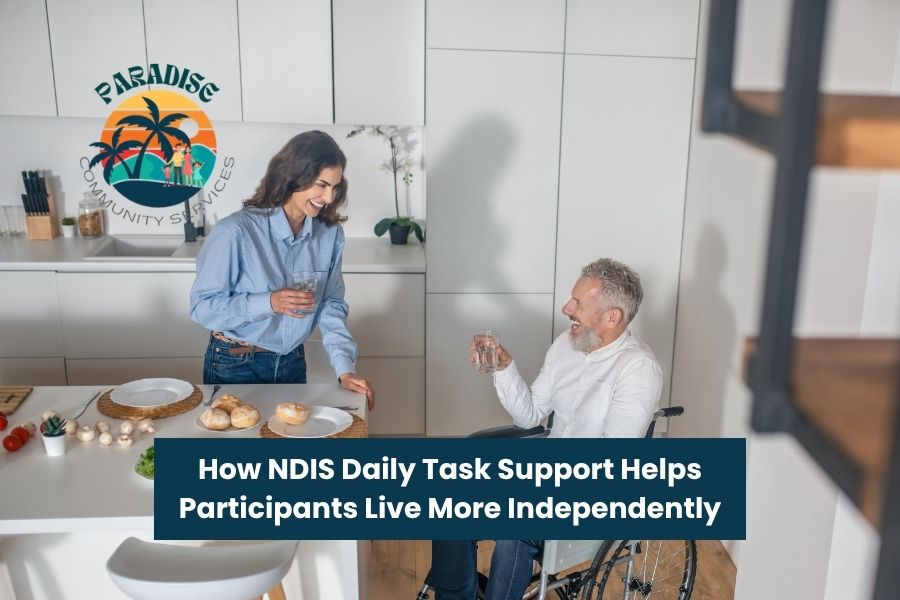
Australia’s disability sector is undergoing its most significant shift since the introduction of the NDIS. With the 2026 “Getting the NDIS Back on Track” reforms now in effect, access to NDIS daily task support has been notably restructured. It’s no longer just about receiving a budget; it’s about understanding a high-stakes framework designed to ensure every dollar spent directly translates into participant autonomy.
At Paradise Community Services, we view ourselves as more than just a provider—we are your strategic navigators in this new era. Whether you are living in the heart of Perth, the suburbs of Melbourne, or regional Toowoomba, the shift toward New Framework Planning affects you. This guide is built to help you master the 2026 rules, ace your next assessment, and ultimately use your NDIS assistance with daily life to build a life that is truly your own.
1. What Exactly is NDIS Daily Task Support in 2026?
In the simplest professional terms, NDIS daily task support is the practical, hands-on assistance that enables a person with a disability to manage the routine requirements of an ordinary life. However, since the landmark Section 10 legislation took effect, the definition of “disability support” has been strictly codified to separate disability-related needs from everyday cost-of-living expenses.
The New Definition of “Allowed” Supports
As of 2026, the NDIA (National Disability Insurance Agency) operates with a “Support List” that leaves no room for ambiguity. To be funded, a daily task must be directly related to your functional impairment.
- Included: Personal care (showering, hygiene), complex bowel and bladder management, meal preparation (the labor, not the ingredients), and domestic assistance (cleaning, laundry).
- Excluded: General groceries, rent, luxury items, or standard household furniture that any Australian would buy.
The goal of this distinction isn’t to be restrictive, but to protect the scheme’s sustainability so that those with permanent and significant disabilities can rely on NDIS daily activities funding in Australia for the rest of their lives.
2. Navigating the NDIS Support Budget: Core vs. Capacity Building
To get the most out of your independence, you need to understand the architecture of your NDIS support budget. In 2026, the “New Framework” introduced a level of flexibility we haven’t seen before, but it comes with a higher requirement for participant accountability.
Core Supports: Your Flexible Engine Room
Most daily task support sits within your Core Supports funding. In 2026, this is often a “Flexible Budget” block. This is a massive win for independence. It means if you have a week where your health is “top-notch” and you need less help at home; you can redirect those funds to “Social and Community Participation” to get out and about. Conversely, if you have a health flare-up, you can pull more hours into in-home personal care without needing a formal plan of review.
Capacity Building: The Pathway to Self-Reliance
While Core Supports are about “assistance,” Capacity Building is about “learning.” If your goal is to eventually live in your own apartment, your NDIS plan for daily activities might include a support worker who doesn’t just “do” your laundry but teaches you how to use a modified washing machine. This “skills-based” approach is what the NDIA wants to see in 2026, evidence that your support is helping you need less help over time.
3. The 2026 Support Needs Assessment (SNA): What You Need to Know
In the case that your plan will be reviewed in 2026, then you are likely to be introduced to the Support Needs Assessment. This is in lieu of past, usually stressful planning meetings where a more redundant, evidence-based dialogue will be present.
The I-CAN v6 Tool
The NDIA now uses the Instrument for the Classification and Assessment of Support Needs. This isn’t a medical exam; it’s a functional assessment. You (with your advocate or family members) will be placed in a setting with a trained assessor and discuss your life in a few domains:
- Self-Care: Are you able to take care of your hygiene?
- Communication: How do you communicate with the world?
- Home Life: What do you require to make your home safe and clean?
- Mobility: What is your movement in your surroundings?
Strategy Tip: During your SNA, focus on your “average-to-worst” days. If you only describe how you feel on your best day, your budget for assisting personal activities of NDIS may not be sufficient to cover you when things get tough.
4. How Daily Support Drives Participant Autonomy
It’s a common misconception that having a support worker makes a person “dependent.” From a senior strategist’s perspective, NDIS daily task support is actually a tool for energy management.
The Spoon Theory in Practice
Most of our participants have very few spoons (or energy) in a day. When you use all your own strength in tiring physical activity such as scrubbing a bathroom or making a complex meal, you will have no power to work, study, or have friends. By using NDIS registered provider for daily tasks for the high-friction “chores,” you are buying back your energy to spend on the things that build a fulfilling life.
High-Intensity Daily Personal Activities
Practical task assistance is literally life-sustaining in case of participants with more complex needs, who may need PEG feeding, catheter care or ventilator management. The NDIA has acknowledged the increased cost of this care, and NDIS price limits are currently fixed at about $75.98 per hour of high intensity weekday care. This will make sure that you are able to afford the highly skilled employees that you need to keep you safe and independent even at home.
5. 2026 Financial Compliance: Hourly Rates and “Debt Recovery”
Let’s talk turkey. You should know the numbers to work efficiently on your plan in 2026. The NDIS is not a set and forget system; the NDIA is currently monitoring the spending to ensure that it matches the “Allowed List.”
Current NDIS Price Limits (2025-2026)
- Normal Weekday (Daytime): $70.23 per hour.
- Public Holidays: More than $150 an hour.
- Sleepovers: A fixed price (typically approximately $270-$290) for an 8-hour stay.
The Section 10 “Grace Period”
The NDIA has acknowledged that the new 2026 rules are a lot to take in. There is currently a $1,500 grace period for accidental “banned” purchases. If you accidentally spend a small amount on an item that isn’t on the “Allowed List,” you generally won’t be forced to pay it back, provided it was an honest mistake. However, working with a NDIS registered provider like Paradise Community Services eliminates this risk entirely, as our systems are pre-coded to align with the Section 10 rules.
6. Why Paradise Community Services is the Choice for 2026
With the 2026 reforms moving toward mandatory registration for SIL and complex care, the “cowboy era” of unregistered, unvetted providers is ending. Paradise Community Services has always operated at the highest level of compliance.
Culturally Safe and Local
We aren’t just a business; we’re part of the community. We know that for many Australians, including our Arabic and Dinka-speaking participants, the “human” element of care is paramount. We don’t just send a worker; we match you with a person who respects your culture, understands your local area (from the Perth hills to the Toowoomba Range), and shares your interests.
Data-Driven Independence
In 2026, the NDIA wants to see outcomes. We use advanced reporting to document how your NDIS daily task support is helping you reach your goals. When it’s time for your plan to review, we provide evidence-based reports that show exactly how your funding has increased your independence.
Frequently Asked Questions
Can I use my NDIS funding for a cleaner if I live with my parents?
This is a common 2026 query. Generally, the NDIS will fund cleaning for the participant’s private areas (bedroom, ensuite). They will not afford house cleaning of the entire house of the family because that is deemed a joint duty.
What happens if my Support Needs Assessment (SNA) results in a lower budget?
Internal Review of Decision is your right. In 2026, you can also escalate this to the Administrative Review Tribunal (ART). We recommend having a Support Coordinator or a trusted provider like Paradise to help you gather “functional evidence” to back up your appeal.
Can I hire my family members as support workers in 2026?
The NDIA is very strict about this. Generally, the answer is no, unless in extreme circumstances (like living in a very remote area with no other providers). The NDIS is designed to provide professional support so that family members can go back to being “mums, dads, and siblings.”
Is gardening covered under NDIS daily task support?
Yes, for basic safety and accessibility. If your lawn is a trip hazard or you can’t access your front door because of overgrown shrubs, the NDIS can cover the labor to fix it. They won’t cover “landscaping” for aesthetic purposes.
Conclusion
Navigating NDIS daily task support in 2026 is undoubtedly more complex than it used to be. The introduction of the New Framework, Section 10 lists, and the shift in assessment models can feel overwhelming. However, these changes are ultimately about one thing: making sure you get the right support to live your life, your way.
At Paradise Community Services, we’re here to take the stress out of the “system” so you can focus on the “living.” Whether you need a hand with the morning routine, help keeping your home in top shape, or guidance on navigating the 2026 reforms, our team is ready to have a yarn.
Ready to maximize your NDIS plan? Don’t wait until your next review to get the support you deserve. Let’s sit down and look at your goals today.
Contact Paradise Community Services Today. Give our friendly team a call on 0865801582 or 0422 248 765. You can also visit us at 62 Fremantle Rd, Gosnells WA or reach out to our local Toowoomba team.